Showing posts with label Albert Einstein. Show all posts

Saturday, 24 September 2016

Time Ravel

Do you know how to time travel?

If you do, go back in time the few seconds spent in reading this and do something constructive in the mean time.

If you don't, read on.

Tick-Tock
Sixteen-and-half years into the new millennium, we are accustomed to the pleasures and pains of this century. You may be a millennial-generational freak to boot hell-bent on rocking the entire planet to your psychedelic tunes, or you may be one of those geriatric oldies lamenting the early demise of the gone-by era - the vagaries of this century are unfamiliar to none. So not many of us would be at a loss to appreciate the multiple paradigm shifts the world has gone through in the last few centuries. To a nineteenth century kid thrown into 2016, what he sees around him is nothing short of sheer fantasy and inconceivable absurdities to his overwhelmed 1800's mind and body. Likewise, I fear I shall be a complete misfit in any social gathering of 2116, were I thrown in there today. So, while in the company of Today, my good friend, I casually put my dreaming spectacles on, and get ready for a double-blind-date with two charming maidens, namely Yesterday and Tomorrow...

Fiction has been at it for a long time now.
It is a passionate wish to know the unknown and see the unseen which has driven our civilization to where it is today. We are all idolators of Science and Logic; Technology and Engineering fascinate us. But what was it in the first place which initiated the logical human brain to drive our limits further and not rest till the unconquered has not been conquered? It is not science, nor logic, but an illogical and emotional urge. This urge is compelling us to keep straining at anything which by nature binds us. Tell a child "Fire is dangerous!" and he'll have an immediate desire play with it, a desire would probably not have been so strong in the first place had the Fire Rule not been stated. We never grow out of our childhoods, so the men of Science have been at this since eternity, trying to break the rules that Nature has apparently put down for us. Lo and behold, we keep on succeeding! Prior warning; this is not a scientific journal article, and hence should be read in right spirit.


We perceive reality (as of now) through four dimensions, of which the first three constitute the realms of Space. Now these three have been conquered, conquested upon, pummeled like punching bags, and made to adjust themselves in every way thinkable for human convenience. It is no longer a big deal to conquer space by traversing through it. NASA's Voyager 1 has left the solar system and has started interstellar travel, and that should be seem like long enough a journey for most humans, some of whom find even the distance between the bed and the water bottle on the dining table so immense that they have to make do with feeling thirsty... Inertia, you see. But jests apart, the bigger picture says that Coordinate Axes X-Y-Z, you don't stand a chance in front of us. Which, in turn, brings me back to my speculative double-blind-date for the day!
Voyager 1

"Yesterday is History; Tomorrow is a Mystery; Today is a gift, and that is why we call it Present!" An old adage, encountered by me for the first time as a twelve-year-old. That seventh-grader back then was an innocent naïve kid all wide-eyed and gullible, just starting to explore the world. The proverb did not make a lot of sense back then. "Today" seemed nice enough a friend, but how exciting it would be to relive Yesterday and have a short glimpse of Tomorrow! Also I was slowly getting interested in time-travel paradoxes and other stuff back then, so the past and the future were super-exciting prospects. Well, not that I would have particularly wanted to kill any relatives, or get involved with strange-acting bartenders (check the links for explanations, in case you you have not got them already!), but speculative prospects of time travel were nevertheless exciting!

There comes the problem. The fourth dimension called Time is as rigid and inflexible as they get. Strain and fight as you may, but you do not have an iota of control over the tick-tick-tick of your wall clock. I am tempted to say that in all likelihood we never shall, but what justification can I provide for that? It probably is ingrained into our mindset. We have been brought up with the counsel time is valuable beyond all, and time lost once is lost forever. These statements while being made to a child unwilling to study are not spoken as assertions of scientific facts, but in order to imbibe the general virtues of punctuality, obedience and whatnot within the kid. This has resulted in us all growing up with a feeling of reverence towards time. "Time" is absolute, unalterable and immutable; something akin to what a dog feels while pushing at a wall it cannot move.

But has the dog ever heard of a thing called a bulldozer? It probably hasn't. Perceptions change over time. Just a century and half ago, a journey from India to England meant a journey of months, and you were not too sure if you would embark alive from the boat or packed in a wooden casket. Could it be imagined back then that one day we will be able to perform that same round trip in 24 hours and be back to have dinner with the family? Such suggestions would probably have been scoffed at. But then the Wright brothers appeared, with a crazy scheme and an even crazier contraption purported to give man wings. The rest is aviation history. My regards to their engineering prowess, but spare a thought for the change it brought to human perspective and vision as well...
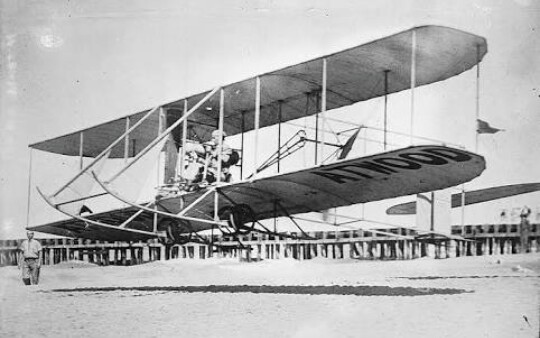
The Wright Brothers' airplane
Why do I wish to unravel the mysteries of time? Primarily, to learn from the past and to build for a better future. I would wish to see how my city looked like fifty years younger, to know when (if at all) cancer finds itself a cure, and to waltz in the ballrooms of The Titanic as it left the ports of Southampton! Does that mean I am not satisfied with the present I have built for myself? Oh I sure am. If my life is a snowstorm then every single day is a snowflake, beautiful and pristine. When layers and multitudes of exquisite snowflakes descend together, the beauty of the snowstorm is captured. As a flake is slowly floating earthbound, there is no point in looking down at the ground for erstwhile crystals now lying in the mud, or gazing up at the clouds hoping to discover more snow yet to come. Focus instead on what is in front of you and what you see is a sparkling-white landscape in all its glory.

Excuse me for now; I have a date to attend!

"Learn from yesterday, live for today, hope for tomorrow. The important thing is not to stop questioning." - Albert Einstein.

P.S.: Thank you Wait But Why for the idea behind this post. I recommend all readers to go through it and become disciples of awesome Tim Urban.

Wednesday, 8 June 2016

In Sotto Voce

"One good thing about music, when it hits you, you feel no pain." - Bob Marley.

If an alien from Mars descended on the roof of your residence tonight and inquired of you to explain to it this strange earthly phenomenon called music, which is totally unknown to its home planet, how would you answer? It would be exceedingly difficult, because the moment we are binding ourselves to the spoken word while trying to enlighten someone to music, we are attempting a futile exercise, which is akin to taking a blind man to an exhibition of exquisite oil paintings by Italian masters. Easier, therefore, would be to play the alien some music, and then call NASA.


Where words fail, music speaks, said Hans Anderson. There are 4500 languages in the world that are spoken by at least a 1000 people or more, and most of us do not understand more than three or four of them. The musical idiom is as diverse, if not more, but the difference lies in the universal embrace of every human into the realm of music. You may be an absolute layman with zero musical training, or you may be a performer at the Berlin Philharmonic; the depth of understanding of the art form surely differs, but  the Deity of music is equally welcoming into her world to all those who knock at Her gates...

The hills are alive with the Sound of Music.
When was I introduced to music? Some fond recollections bring forth three early memories: an album of nursery rhymes by Preeti Sagar which used to play in our old cassette player now defunct, the humming of Robindroshongit by my mother on Sunday mornings, and The Sound of Music, one of my first ever films. Today when I relive the movie, I am enchanted by the sheer beauty of the story and the depth of emotions portrayed, but back then it was simply the sight of Julie Andrews - running down the green Austrian countryside with the seven children at her side, singing with gaiety and abandon, in simple tunes, about her most favourite things - and how beautiful it was! I felt as happy as little Gretl von Trapp.

From LP's....
Childhood memories fade away as you grow up, and Preeti Sagar now probably lies at the back of some cupboard. Our generation is a lucky one to have passed their teens and adolescence through the period when the internet was fast becoming a household thing. As a result, through our advancing years and changing tastes, we were constantly able to utilize the internet to keep our tastes updated and ears buds satiated. Imagine a generation or two back, and the contrast is glaring. From LP gramophone records to bluetooth headsets via stereos, cassette players and Walkmans, the evolution of music playing devices itself speaks a volume about the change in the music scenario.

....to stereophonic devices.
Amidst the confusion of Growing Up when every kind of music was jostling for space in the playlists, western classical music came and stood softly beside me. The fickle minded child in me took quite some time to adjust to this new, apparently complicated, and tough brand of music. There was no way I could really get the hang of things quickly and everything was seeming vague and pointless! Maybe it was an indication of deep roots spreading well below the soil, but once the plant bloomed it was there to stay. It really does not take rocket science to decipher why classical music is not as popular among the masses as most other forms of music are, for it is pure and unblended. Anything refined is difficult to master, requiring perseverance and patience above the ordinary.

Johann Sebastian Bach, Baroque master.
More than half-a-millennium ago during the Renaissance days, when civilization in Europe was emerging from the Middle Ages, the classical form of music started being written. Back home in India, the origins are traced back to the Samaveda which is said to have been written so that the verses of the Rigveda could be sung in the form of hymns. With progress of the centuries these forms evolved further. Indian classical was classified into Hindustani and Carnatic, with further categorization into Gharanas. Western classical, on the other hand, progressed through period-ages, starting with post-Renaissance Baroque, moving on to Classical, Romantic, and eventually Twentieth Century music.

Popularity speaks for itself, one might argue. In any part of the world, contemporary popular music is ruling the charts, while only those trained in the subject may be able to appreciate classical music. Music is after all for the heart, and no composer should expect his or her audience to consist of only the musically proficient and erudite. To them, I would iterate that behind any genuine musician performing in any genre under the sun, there is a profound influence of classical training, in some form or the other. Examples in this regard are numerous. Coming from the land of Tagore, we need to appreciate that a large number of the Bard's songs have been influenced by classical music, of both the Orient and the Occident, which ranged from Irish and Scottish tunes to Carnatic music from the South of India. For someone interested, this is an absolutely wonderful blog post I ran into while Googling for some information in this regard. The point thus remains that if one is patient enough to build a firm grasp over the forefather of all musical forms, diversification into other genres comes naturally.

Zubin Mehta conducting the Bavarian State Orchestra at Srinagar.
To conclude, I wonder, how well off are we Indians in this sphere? Not very. It goes without saying that we all enjoy music, more so the young generation. Maybe it is an enjoyable pastime, or maybe as a style statement it serves good purpose; interpretation is up to the listener. Having said that, how easy is it for an average Indian young adult pursuing music with heart and soul, genuinely talented in the field, but lacking contacts at proper places, to get a break into the tough music industry? The platter being served before the audience is delicious, but the way through the kitchen is grueling. You may put the blame onto the Great Indian Mentality (read fearful parents and discouraging society), or on the way our entertainment and music industry flourishes on nepotism, or on the sheer lack of opportunities for a talent to flourish: the reality remains that scores of talented youth with a passion for music are being forced away from music into some profession grossly unsuitable and depressing. If a nation's economy is in the doldrums, one or two good governments can rectify the problem. But if the psychology of an entire people needs uplifting, it takes generations for the change to come.

Being an ordinary pursuer of music, I am happy to let music remain as a source of satisfaction and stability in my life, like the thousands of other youth devoting their life and time to other fields but harbouring profound love for music. At the same time, the thought of the pool of musical talent available in my country which is not being tapped, fills me with despondency. This post is dedicated to all the men and women out there with music in their hearts and and melody in their souls, who solely for the want of opportunities could not bring their true potential to materialize....


"If opportunity doesn't knock, build a door." - Milton Berle, American comedian.

Monday, 9 May 2016

Musings of an Engineer

In the 21st century, expectation has a synonym in duty.

Being an engineering student, in a little over two years time from now, I will be expected to have gained sufficient knowledge and enough skill in this profession the wise men named engineering, to carry forward a tradition more than five-and-half thousand years old, when the wheel-and-axle was invented in Bronze Age Eurasia. Have a look at the earliest image of a wheeled cart, excavated in Poland, and then at the smartphone in your hand. The weight of the heritage, for sure, is not a light one to bear.

How would our world be without these?
Adam and Eve were the finest creations of God. What separates their descendants from the 8 million other species of co-inhabitants is a superior brain and a will to modify our environs in a manner most suitable for us. Microeconomic theory assumes that human psychology compels man to strive for the circumstances and situations among various restrictions which provide maximum utility or satisfaction to him. In layman's language, I would rather use a plough rather than dig up my field with bare hands, given that I do not own a tractor. It was easy enough to break a branch off a tree, but the difficulty lay in sharpening its point, attaching a metal tip and building a device that throws the arrow with sufficient speed to maim the deer it was aimed at. Thus started the trade of engineers: Modifying the environs to obtain maximum utility.

The developers of the earliest wheel, and then in the course of time the potter's wheel, the iron tools and other similar items, hugely important though they were in terms of contribution, cannot be called engineers by today's definition, for back then trade was based on the principle of trial-and-error. As science was yet to develop, the practice lacked the strong foundation which physics and maths were to give it later on. Still, that does not in any way take away the skills and contributions of those ancient engineers who without any firm scientific knowledge had perfected their skill and passed them on through generations. Post the Industrial Revolution in Europe and the emergence of USA as a world power, engineering was here to stay. Nevertheless, as in any emerging field, at that point educated and qualified engineers were still rarities and were treated with lots of respect.

How NOT to misuse a boon of Science.
And look how it all has changed! The 19th and 20th centuries came up with two brilliant inventions which were to change for ever the way life is lived on the planet. We got electricity, and we got the computer. The paradigm shift caused by each was to alter human wants on a fantastic scale, and the onus was on the engineers to provide for the increased demands. Science provided the solid bedrock for engineers and the newest playthings available in an engineer's nursery seemed intent on breaking every restriction there had ever been on human satisfaction. And in some cases, human stupidity.

"Science is about knowing; engineering is about doing", said American author Henry Petroski. As of today, engineers happen to be ruling the roost. One comes across endless inane social media jokes trolling engineers, but one of the more accurate ones described a postman asking a shopkeeper where the house of the local engineer was, and eliciting the reply "Kisi bhi ghar me ghus jaao, yahan to saare engineer hi hai...". Jests apart, engineers are to be found at a dime a dozen these days. Growth in number of colleges across the length and breadth of the country which purportedly teach engineering is akin to that of shopping malls. In some of them, the quality of engineers produced should be placed under consideration.

As always, centres of absolute excellence have come up and are thriving. They absorb the finest brains of the country and develop them into skilled professionals. These institutes are cause for pride, and not of concern.
An error of judgement.
What should be worrying us instead, is the army of not-so-skilled engineers who are also populating the market. Whether it be lack of brains, poor undergraduate education or lack of discipline and honesty, these wannabes (for want of a better term), are not quite bringing to the table what his or her profession demands. What it results in is dilution of the skill of an entire workforce. A very ironic and saddening comment in this regard comes to mind, coming from one of the best professors I have had the opportunity to learn from. With absolutely no disrespect to the medical community, it was sometime last year that he had made this observation in class. When an unskilled surgeon makes one incorrect incision during an operation, one patient dies. When an unqualified engineer makes one error of judgement while designing a flyover, scores of people die underneath. Little did any of us guess that at that moment somewhere in the city such a fatal design was on its way to construction, acceptance and eventual devastation on an overwhelming scale.

Why do we all want to become engineers? A brief survey tells me that the recurrent justifications are a secure future, an assured job (?), an appeal for a technical branch of education, and promise of a (comparatively) easy student life. Some students did maybe make a bit of a sacrifice in letting go of subjects where they had a bit more interest, but not all such cases are as heart wrenching as Farhan Qureshi's... A matter of deciding in favour of the greater good for the future. In my case, it was a combination of all, but primarily an inclination towards applied sciences instead of theory. How far these expectations are realized is a separate topic for debate, but maybe in some cases, there were other reasons for this choice of career, that it was the only option available to pursue, and all the friends were doing it.....

In harmony.
It is not I but far wiser men who have stated that distinctions between subjects do not exist in reality; only in our perceptions of it do we have them. CV Raman, a distinguished pianist himself, said that Science is the highest form of Creative Art. Software is a great combination between artistry and engineering, according to Bill Gates. Indeed, the greatest engineering marvels of the world are known more for their artistic and cultural value. Art cannot sustain itself without engineering assistance, while a fine creation of an engineer is dry without art. The traditional feud between science and engineering is meaningless as well, for without either the other would fail to exist, even in the most rudimentary form. But, considering the manner in which we perceive things, subtlety is maybe not the most prominent quality! Science. Commerce. Engineering. Humanities. The walls that separate them in our minds are as prominent as the full-stops between the words...


An engineering marvel, and an artist's dream.

It is early days for me, and I have no idea yet as to how good or how bad an engineer I will become. Marks do reflect some of your capabilities, but not a lot. Which is a good thing and a bad thing, considering how marks-dependent our evaluation system is. Even the admission criterion at most engineering colleges is solely dependent on how much less of brain-freeze you are suffering from during three hours of an entrance exam! So instead of harping on how tough it is to survive today as I did in a previous blog, it would rather be of more benefit if I returned to the perusal of the syllabus of my upcoming semester. The next two years would see me graduating along with a flock of fellow engineers, each trying to outsmart the other. Those among us whom the education system and the industry would be deeming suitable for this ancient trade, would continue along the well trodden path and lead the contented life of an engineer. And those of us who will be rejected at the industry's sieve would be forced to look at other shores for sustenance, greener or otherwise!

"One man's magic is another man's engineering. Supernatural is a null word": Robert Heinlein.

Sunday, 17 April 2016

Growing Up

"Your children are not your children. They are the sons and daughters of Life's longing for itself." Kahlil Gibran in The Prophet.

God is perfect, they say, and so are his creations. Every object of nature is perfect in itself; pure and not interfered with. Through humans, God passes along the purest of the pure, the most sacred of his creations: the human child. Upon this newborn, from the moment it sees the light of the world through the gifted hands of the hospital surgeon or the rural midwife, a process of tampering starts. Tampering God's own creation with the elements of the human world, which entails the process of getting the child prepared to spend a lifetime in a tough place. Preparation never ends, and we 'learn' till we have exhausted our last breath, but a majority of life's lessons are imbibed in the formative years of childhood. A long, slow but steady process, where every day is a new lesson in life, every step the next milestone crossed, in the journey called Growing Up.

Hello there! Welcome to the world.
Human memory is a strange device. It picks and chooses arbitrarily at little occurrences and incidents which have no role to play in the larger scheme of things and keeps them stored, while major parts of the process of growing up is deleted from the mind of the growing child itself. My first ever memory inexplicably involves stepping into the balcony with my brother at the apartment we used to stay in when I was two-and-half years old. The next three years is like a film roll with a lot of parts damaged: an occasional birthday, a day at nursery school, a visit to grandparents and maybe memories of a scolding or two from my mother. Yet this is the period of frantic brain development. A UNICEF report says: "Brain development occurs shortly after conception and progresses at a very rapid pace in the first few years of life, where neurons form new connections at the astounding rate of 700-1000 per second." Read the full report here, which throws light on the fascinating object that a child's brain is. In this context, I remember going to a close family friend's five-year-old son's birthday bash, and wondering how much of this extravagance the child is going to remember by the time he is an adult...


Albert Einstein believed in keeping the child within him alive.
Through the infant days to getting into school, teenage, adolescence and finally adulthood, the conditioning of the brain is a continuous process, while the sole motive remains to gain the required skill sets needed to lead a comfortable life as contented as possible. The interpretation of 'comfortable' changes as the decade pass - what my grandfather would have called comfortable in his young days would no doubt be a rather spartan existence for me - but I'm sure that both of us would be on the same page concerning the bumps and potholes along the road to adolescence and young adulthood. The nature of the challenges change but the challenges themselves remain.

A report in The Hindu on heavy Indian schoolbags.
Confrontations are umpteen and rise in number with every passing day. The first burden upon a child is that moronic system that we call Education which seeks to suffocate a child in every way possible. I myself have escaped suffocation by the skin of my teeth. The civilized world runs according to some rules, and coming to terms with some of them takes a lot of struggle as well. For me, learning to welcome self-invited guests with a smiling face and to hell with how irritated you are to have them was one such lesson. To a teenager, issues like social acceptance and likeability are so very important, and upon which topic this blog by Tim Urban on the Wait But Why website is one of the best I've ever read. Even if I ignore adult problems like family issues, financial burden and the million other factors which in fact affect the child of the family as well, a kid has a lot of things on his plate.

What is it that defines growing up? Is it that span when one makes mistakes and the mistakes are accepted? Is it distinguished by an innocent outlook of the world where initially everything is in black-and-white, and then slowly all turn to grey? Kailash Satyarthi puts it very nicely: "Childhood means simplicity. Look at the world through the child's eye - it is very beautiful." A child's world is indeed beautiful, but therein lies the counter argument: If I, an adult, am longing for the simplicity of youth in my surroundings, then am I not hiding my face in the sand and not facing the world as it is in stark reality? Taking this stream of logic further, if we identify the inability to recognize and react to the society's realities as they are as a sign of immaturity, then are maturity and simplicity of thought counter-concurrent? These are questions I do not really know the answer to. But maybe a solution lies in raising the collective consciousness of the entire people so that contrived and superficial existence is no longer necessary and a child's world may be the reality... Wishful thinking.
Saviour of so many: Kailash Satyarthi

I am completely at peace with the life God has bestowed upon me, and I spend every moment trying to live the day more fruitfully than the day before. But the echo of my childhood which still remains in a secluded corner of the soul calls me everyday and shouts out how much simpler life was when I was young. People realize the importance of having nice teeth only when they are sitting on the dentist's chair, just as do young people ignore the premonitions of elders that the youth is precious beyond all else and should be spent wisely. "In youth we learn, in age we understand.", said Marie von Ebner-Eschenbach, Austrian novelist, and what a big pity that is. So let us at least make an effort, immature and raw though we are in our days of youth, to live life to its optimum in these few years left before the world squeezes out the last ounce of life from our souls!

Can this joy ever be paralleled?
If you are in a hurry to grow up, you miss all the fun.